Possible users, buyers, markets and use stories remain hypotheses. Annual results close on 31 October 2026. Later preparation work is identified separately.
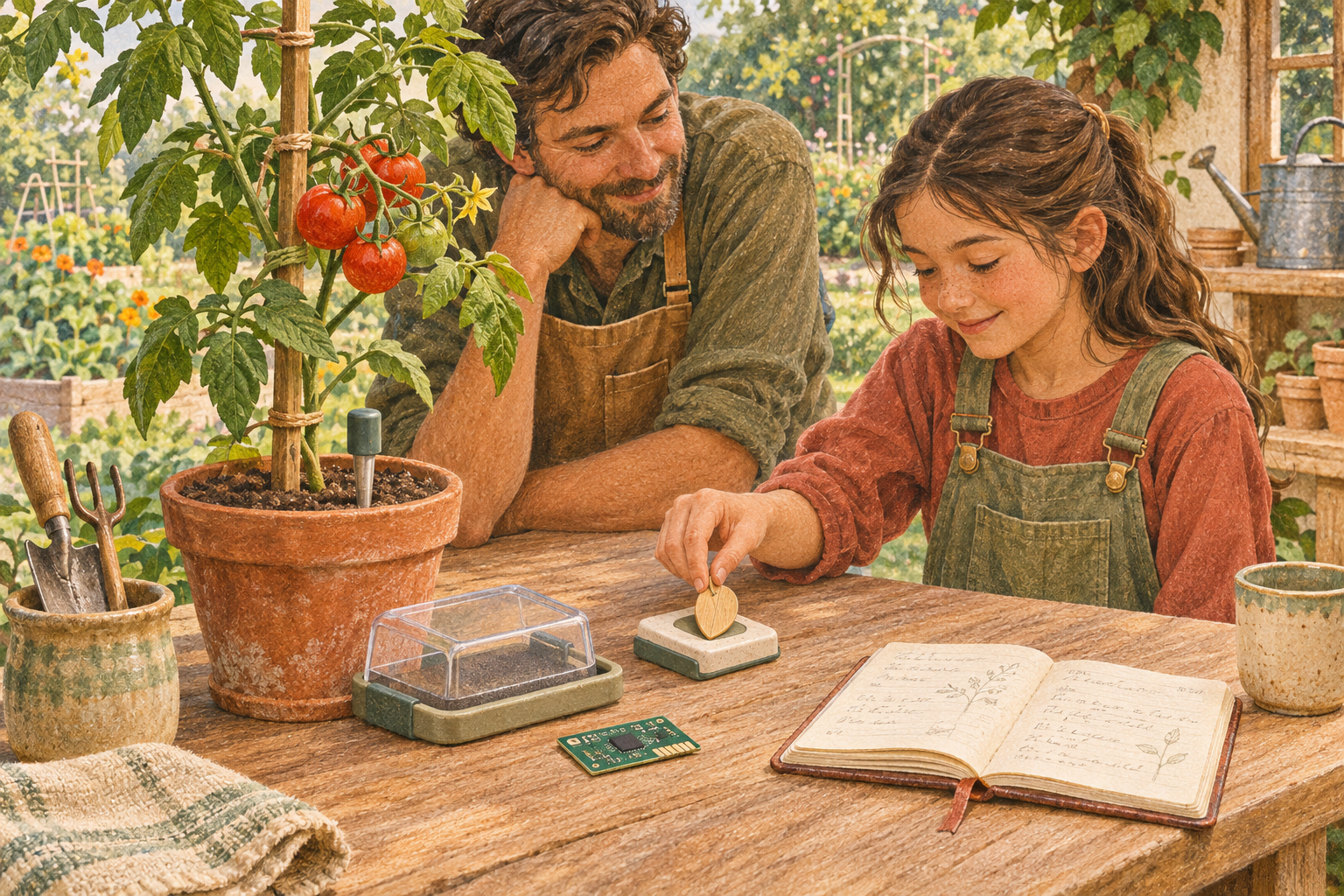
AI illustration of an imagined encounter.
One Possible Use
A child taps a leaf token after a garden walk. The reader opens the plant's notes and last month's drawing.
EDITORIAL MAP · WORK AND PROPOSED HANDOFFS
The Idea
Small tokens and tags meant to open a record when tapped on a reader.
The Problem
Young learners can struggle to find a digital record when they are holding a real object.
Who Could Use It / Who Might Pay
Children, families and exhibit visitors. Possible buyer: Parents, schools or museums.
Market To Test
Learning tokens, exhibit labels and object records.
Other Choices
A printed label or QR code is a cheap choice. Arduino can support custom reader projects. [A01]
Our Idea And The Trade-Off
Let a leaf token, ID card or key tag open the right story with one tap. A QR label is simpler to print. Tap tokens need readers, durable parts and useful records.
What Happened In 2026
Three linked token forms are described. A complete tap-to-record working test is still needed.
What Comes Next
Make all three forms work with one reader; check strength, privacy and safe use.
The 2026 concept describes a shared identity system across the three forms. It connects the leaf vocabulary with personal cards and tagged objects. The common design is documented; a complete working encounter still needs to be demonstrated.
What if a child could hold a concept in their hand, bring it to the world, and use it to tell Atlas what to notice, do, draw, hear, compare, collect, or investigate?
The product
A physical vocabulary for the world.
iNQ.cards and Atlas form an integrated learning system that turns physical concepts, real-world exploration, and a child's own observations into a persistent personal Field Book.
Each iNQ.card is a durable NFC-enabled glyph representing a concept: bee, leaf, water, hand, mother, sound, sketch, compare, map, why, Spanish, and eventually a vocabulary spanning everyday life, nature, language, science, culture, place, and inquiry.
Atlas is the intelligent field instrument that understands those concepts. A child can tap Bird and listen for a bird; tap Leaf and find one outdoors; add Sketch and draw it; add Compare and examine two leaves; add Spanish and continue in another language; add Map and save where the observation happened.
The cards are not flashcards, and Atlas is not a conventional educational tablet. Together they create a tangible language for inquiry.
Design principle
World first. Screen second.
Most educational technology begins with a screen and asks the child to interact with abstractions displayed on it. iNQ.cards and Atlas reverse that relationship.
A strong Atlas activity sends attention outward: Find something smooth. Listen for water. Show me your hand. Find a leaf. What do you notice about the bird's beak?
Atlas supplies perception, context, guidance, recording, and memory, but the world supplies the subject matter. The device succeeds when it helps the child look away from the screen and more closely at reality.
iNQ.cards
The glyph is a concept, not a word.
An NFC card carries a stable semantic identity rather than a lesson or an English vocabulary item. A Dog glyph might resolve internally to animal.dog. Atlas can then realize that concept as dog, perro, chien, Hund, or 犬 without changing the physical card.
This makes the deck a language-independent conceptual vocabulary. The same card can remain useful for years: a toddler can buzz like a bee, a preschooler can find one, an older child can observe pollination, map sightings, compare insects, record sounds, or formulate an ecological question.
The card is therefore not the lesson. It is a persistent physical handle on a concept across childhood.
Tangible grammar
One glyph explores a thing. Two explore a relationship. Three can pose an inquiry.
iNQ.cards gradually become a physical semantic language. Concepts can behave like nouns, verbs, qualities, relationships, inquiry operators, and context modifiers.
Leaf can mean “explore leaves.” Leaf + Sketch means “draw a leaf.” Bee + Flower invites observation of their relationship. Bee + Flower + Why can become an age-appropriate inquiry into pollination.
The child is effectively constructing small programs for Atlas with physical concepts.
Tell & story: preserve a child's spoken observation or use glyph combinations as narrative prompts.
Predict & experiment: ask what might happen, change one thing, then observe.
Collect & map: build personal collections tied to places and trips.
Remember & ask: reconnect a present encounter with previous ones and turn curiosity into inquiry.
Sketching
Drawing as a way of looking.
Sketching is a first-class Atlas interaction, not a separate drawing app. For the youngest child it begins with mark-making and broad tracing. It develops through copying, observational drawing, feature sketching, memory drawing, and eventually annotated naturalist field sketches.
Atlas can place a live or captured specimen beside the child's canvas, isolate the object from the background, simplify its contour, or create a sumi-e reference. The sequence can move from photo → isolated specimen → contour → sumi-e guide → blank canvas.
The AI rendering is scaffolding, never correction. The child's raw strokes and finished sketch remain distinct, preserved artifacts.
Sound & noise
Learning to listen carefully.
Audio observation has equal status with visual observation. Atlas can ask a child to listen, imitate, match, record, compare, locate, draw, or later analyze sound.
A Bird entry might contain the actual call, the child's imitation, a sketch, a photograph, and the place where it was heard. A Foot + Rug activity can compare footsteps on carpet with footsteps on a hard floor. Water can drip, pour, splash, and flow. Zippers, doors, spoons, leaves, wind, animals, voices, and music all become acoustic material for inquiry.
As the child grows, the same recordings can reveal waveforms, rhythm, pitch, spectrograms, and frequency structure.
Languages
Learn the word through the world, not through translation.
Because the glyph itself is language-independent, multilingual support belongs at the semantic layer. Atlas can operate in a home language, vocabulary mode, bilingual mode, immersion mode, comparison mode, or natural code-switching mode.
Leaf + Spanish can prompt Busca una hoja. The physical glyph, the real leaf, the live camera view, and the spoken phrase establish meaning directly. The child need not first translate hoja into English.
Language glyphs can themselves become modifiers: Bird + Listen + French performs the activity in French; Apple + Sketch + Spanish turns observational drawing into grounded language learning.
Atlas Field Book
The experience becomes the record.
The Field Book is the organizing interface for Atlas. A child should not have to “manage a notebook.” They tap, find, listen, move, sketch, talk, and explore; Atlas quietly handles timestamps, location, capture, linking, classification, and saving.
A single field entry may contain a photograph, short video, child's sketch, sumi-e reference, environmental sound, sound imitation, voice note, transcript, object or species hypothesis, location, route, measurements, language, active glyphs, and questions.
Map, journal, collection, and inquiry views are simply different projections of the same observations: Where did this happen? When? What have I found? What am I trying to understand?
Over time Atlas can say, “You found one here last spring,” and surface the child's earlier drawing, sound recording, photograph, or spoken observation. Concepts acquire personal history.
Field instrument
Observe first; capture happens naturally.
Atlas should not force young children through a conventional camera workflow. In Find mode, computer vision can maintain a short rolling buffer, recognize the object of interest, and retain a good frame when the encounter becomes meaningful. The same principle applies to short video and environmental audio.
Identification should support inquiry rather than terminate it. Instead of merely declaring “This is a ponderosa pine,” Atlas can continue: “Look at the needles. How many are growing together?” Uncertain identifications are presented as hypotheses, not facts.
Developmental arc
The same glyph grows with the learner.
Atlas adapts activities without requiring the physical vocabulary to be replaced. Early interactions emphasize encounter, movement, sensory experience, matching, and naming. They develop into observation, relationships, measurement, explanation, prediction, investigation, and eventually child-generated inquiry.
Bee can progress from “Buzz like a bee,” to “Can you find one?”, to “What is it doing at the flower?”, to “Let's watch one flower and count its visitors,” and finally to “Why might bees visit some flowers more often than others?”
Repetition therefore becomes repetition with variation: the card remains familiar while the intellectual experience becomes richer.
Durable memory
A GitHub-backed Field Book.
Atlas keeps a local working store so field activity works quickly and offline. Completed observations can synchronize into a GitHub-backed Field Book repository that serves as the durable historical archive.
Each observation can remain an ordinary directory containing structured metadata and ordinary media: photographs, sketches, audio, voice notes, video, and derived Atlas artwork. GitHub provides versioned, inspectable, portable storage rather than trapping a child's learning history inside a proprietary application database.
Raw child work is preserved. AI-generated contours, transcriptions, identifications, summaries, and sumi-e images are stored separately as derived material. Private source records can also be selectively transformed into publishable Field Book entries without exposing precise location, family material, or other sensitive information.
System architecture
Cards provide vocabulary. Atlas provides perception, context, action, and memory.
Physical layer: NFC glyphs and optional Atlas instruments.
The card is a key that turns a concept into an experience.
iNQ.cards provide a physical vocabulary. Atlas provides perception, context, action, and memory. The world provides the subject matter.
Together they let a child hold a concept, encounter it in reality, represent it in multiple ways, connect it to other concepts, preserve what happened, and return to it repeatedly as understanding grows.
The ultimate product is not the deck, the device, or even the software. It is the child's growing personal map of the world.
Harvest 2026
The physical card format, bamboo/NFC direction, seven-year cadence, and 1,008-card ambition established the vocabulary layer. The current product direction extends that foundation into a compositional NFC grammar integrated directly with Atlas, multilingual activity realization, multimodal Field Book capture, and durable GitHub-backed memory.
Before 2 November
Finalize the semantic and NFC data model; produce a numbered pilot deck; implement single- and multi-glyph Atlas interactions; prove Find, Listen, Sketch, Tell, Compare, Collect, and Map activities; connect observations to the Field Book repository; and document the authoring and localization model.